Saturday, October 9, 2021

'Nellie R. Steven's' Holly

Nellie R. Stevens Holly

Ilex aquifolium × Ilex cornuta 'Nellie R. Stevens'

This Holly is one of the most popular Hollys to grow as a screen in the Southern US. Unlike other Hollies, Nellie R. Stevens is more tolerant of high heat and humidity of the South. Thus, this Holly can grow into Southern Florida where others can not. This hybrid is a cross between the infamous English Holly and the lesser known Chinese Holly. Hollies are diocious which means they require a male to pollinate the female so the female can produces berries. However, what is very unusual amongst diocious plants is that Nellie R. Stevens will produce some berries without a male pollinator because it is parthenocarpic (from Greek parthenos meaning virgin and karpos meaning fruit). In order to have the gorgeous profuse abundance of berries will require a male pollinator. Good male pollinators include 'Edward J. Stevens' or any male Chinese Holly. Nellie is cold hardy to -10°F to -5°F. She can be pruned to be a single trunk tree or have limbs to the ground. She can be a stand alone focal/accent or planted together as a screen which is most popular in landscaping.


Hardiness: USDA Zones 6-10 (Protected areas of zones 5b/6a)


Mature Size: 20'-30' tall by 10'-15' wide


Light: Full sun-Part Shade 

(Tolerant of some shade; will become very sparse with fewer berries in dense shade)


Water: Average-Moist

 Extremely versatile for a Holly. Tolerates poor soils from dry to moist. Will tolerate some flooding.


Soils: Performs best in acidic soils 

Unlike most Hollies this hybrid will tolerate slightly alkaline soils, but will not survive very high pH. Add soil acid to lower pH if soil is alkaline. Tolerates dry to moist soils. Very versatile compared to other Hollies; Tolerates compacted soils, and sandy soils. 


Deciduous/Evergreen: Evergreen

Monday, September 6, 2021

Southern Magnolia More Hardy than You Think

 Southern Magnolia

Magnolia grandiflora

The Southern Magnolia is perhaps the most popular broadleaf evergreen tree in North America. Very large glossy (plastic like) green leaves can be up to 10" long and large very fragrant flowers that are citrusy in smell that can be up to 12" long. Due to mass cultivation of this species it has naturalized much further North than its historical native range (I circled). Cultivars exist that are more cold hardy that grow a zone North than the regular species can tolerate. The Southern Magnolia is hardy in USDA Zones 6-10. A couple cultivars that are zone 5 hardy are 'Bracken's Brown Beauty' and 'Edith Bogue'. The large deep glossy foliage adds a lush tropical look to the frigid and gray Northern landscape. 


Magnolias in general prefers soil more on the moist side rather than drier side. The species depends on exactly what they prefer. Southern Magnolia prefers moist well draining soils. They are drought tolerant once established. They can not tolerate wet soils, but can tolerate occasional flooding. The other species of Magnolia The Sweetbay Magnolia tolerates wet soils al the way to even some drought. The main physical difference is Sweetbay has much smaller foliage and blooms. The other phsyical difference between the two is that Sweetbay Magnolia is semi-evergreen/deciduous in Northern regions.


Many cultivars of Southern Magnolia exist from columnar, dwarf, to improved foliage.. the 'Little Gem' cultivar is dwarf not getting bigger than 20' tall, but is less hardy than the regular species hardy only in zones 7-10. 'Alta' is very columnar cultivar for small or tight spaces. Also the the ones more cold hardy are listed above. Southern Magnolia is most popular within the US, but is cultivated around the world due to its unique qualities you can't find with any other tree. It is native to the Southeastern US. It has naturalized all the way to Arkansas, Tennessee, Washington DC and others. The species only is native in USDA Zones 8-10a (10a being Tampa the Southern most tip of the native range) I have seen the tree landscaped as far South as zone 10a in Naples Florida. The trees seemed stunted and performing poorly, likely too hot with limited dormancy periods. Very much like Boxwood in zone 10 that gets more disease issues with the hotter climate. The Southern Magnolia performs best in zones 6-9, but is capable of growing in zone 10, but extra water or some afternoon shade may be required. I have successfully grown 'Edith Bogue' Southern Magnolia in Carmel, IN (USDA Zone 5b). At the coldest point it survived -13°F with severe winter burn, but every branch foliated the following Spring. There is a mature specimen in Carmel as well that has endured temps slightly colder than -20°F in the winter of 2014 with nearly complete defoliation, but every limb survived and foliated the following Spring.

Native Range of Magnolia grandiflora


Area circled is Magnolia grandiflora rough generalization of species being naturalized beyond native range (naturalization may occur outside circle especially along East Coast)


'Edith Bogue' Southern Magnolia in Carmel, IN (USDA Zone 5b) 2014 winter for example saw air temps pummet to -20°F with wind chills close to -50°F. Tree nearly completely defoliated, but every single branch survived and flushed out the following Spring. Winter burn begin when winter temps dip below -5°F to 0°F, but stems are hardy to at least -20°F on the hardiest cultivars. Even if a night or 2 falls below zero, the foliage out of direct winds wind face a better chance at staying green, especially if the subzero is brief.

Tuesday, August 17, 2021

Sabal Palmetto


Sabal Palmetto (State tree of Florida and South Carolina)


Native Range (Native also in the Caribbean and Cuba)


Sabal Palm is a lush sub-tropical evergreen, and is the state tree of Florida and South Carolina. One of the most cold hardy Palm trees in the world down to around 7°F. Landscaped all the way up to Tennessee, Virginia, Maryland…

These trees mature anywhere between 30' to 60' tall. A few rare specimens likely over 150 years old have exceeded 90' in height. These trees are painfully slow to grow from seed to desired size. From germination to the first sign of a trunk (4'-5') tall can take at least 10-15 years! This means 20' tall specimens are about 50 years old, and 30'-40' tall specimens are 70-95 years old. This also means the millions of Sabal Palmettos landscaped over 20' tall across the deep South are at least 50 years old. So obviously these trees are not propagated from seed in nurseries. Most of the time they are dug from the wild from private land. Young trees with trunks less than 3' are almost impossible to transplant, but tall ones are extraordinarily easy, and are foolproof option for landscaping. There remains debate how much longer we can keep digging them up from the wild before there aren't enough left to meet the demand. So many nurseries are now growing them from seeds so decades from now Sabal Palmettos will still be readily available when we can't continue to mass dig them from the wild. Super drought tolerant, tolerant of virtually any pH and soil type, and very salt tolerant.


Hardiness: USDA Zones: 7b-11


Mature Size: 30'-60' tall by 5'-15' wide (Few very old wild specimens grow to 90'+ tall)


Light: Full Sun-Part Shade


Water:  Dry-Moist

Grows best in moist well draining soils. Excellent drought tolerance once established. Tolerates wide moisture conditions from drought to moist soils, and some flooding.


Soils: Not particular with specific pH level. Grows in most soils. 


Deciduous/Evergreen:

Evergreen


SOURCE:

https://www.plantrealflorida.org/info/florida-ecosystems/sustaining-the-sabal-palm-floridas-state-tree/

Friday, May 28, 2021

'Flame Thrower' Redbud


'Flame Thower' is a new cultivar of Eastern Redbud, and is the most colorful cultivar out there! 🔥


In Summer it has 4 colors at once on any given branch. The newest growth is deep red fading to orange, to yellow, and then to green on the oldest growth adding a rainbow of color on the tree. 'Flame Thrower' has only been on the market for a few years, so is not a common tree as of yet. Many nurseries however are beginning to offer this plant, as many wholesalers are now growing and selling them. Just like the standard Redbud it gets the same outstanding reddish/purple flowers coating the branches in Spring before foliage emerges. 'Flame Thower' matures to 15'-20' tall and wide. Its maturity is comparable to the regular species. While Redbud is shade tolerant, 'Flame Thower' is not. Unlike other variegated plants 'Flame Thrower' will not burn in full sun. Hardy in USDA Zones 5-9


🌿NatureMan 2021🌿

Monday, October 19, 2020

Indianapolis 2020/2021 Winter Weather Outlook

 Indianapolis 2020-2021 Winter               Weather Outlook


By: Andrew McCurdy


Unlike last Winter, I expect more snow and better chances at cold shots. We are in a La Nina Winter. For our area, you will want a Neutral to Slight La Nina for big cold and snow, but we have a strong La Nina. This doesn't mean a warm and snowless winter, but definitely involves a track of above average precip and good chances for cold outbreaks. I do anticipate the worst of winter to stay up North in the Dakotas, Montana, Minnesota, and Wisconsin areas seeing potentially historic cold outbreaks from the Polar Vortex. Here in Indiana we should get "shots" at polar air, so I don't anticipate anything like the 2014 Winter, but definitely a good year for "Winter Weather Weenies" especially compared to the last few years. 


OUTLOOK


TEMPERATURE:

Average to Slightly Above Average Temps overall (Dec-Feb). Coldest part of winter will likely kick in over the second half of the season. So I expect December and maybe part of January to be Warmer than average with below average precip (including snow). Then to end January through March I expect slightly below average temps with above average Precip (including snowfall).

PRECIPITATION:

Above Average. Slightly Above Average to Above Average Snowfall. Above Average Rainfall. I predict we get 25"-30" of snow possibly more if we cash in a couple big storms. 


Average La Nina Winter


NOAA's Official Winter Outlook


Friday, August 28, 2020

Top 21 BEST Houseplants for Easy Care


To start off this post I want to say there are MANY different kinds of houseplants. The variety ranges from extremely easy and common to exotic "finicky" ones. This list is not like some other sites that list best ones for being a "fad". This is simply my personal favorites for easy care regardless if they are extremely popular or just "plain Jane". I will leave the favorites to you to decide the reader 😉🌿.


Also there are MANY MANY more Houseplants I could have included that are popular and low maintenance, but wanted to end it short n' sweet at 21. 


1. Snake Plant (Dracaena trifasciata and other Spp. Formerly known as Sansevieria)

 Yes, you read that correctly, Snake plants are NOT Sansevieria's anymore. It is a former genus. In 2017 genetic testing proved ALL Sansevieria's to be in fact Dracaena's. The Snake Plant (aka Mother in Laws Tongue) is the EASIEST houseplant to grow! Famously known as being impossible to kill. Can grow in the darkest areas (still needing some light to live, duh) and a couple months at a time without water. Many different species and varieties exist with nearly identical care. 


2. Dracaena fragrans


Many varieties of Dracaena fragrans exsist. Many sources will list such varieties as separate species, they are not. This plant can grow in low light and needs water only once per month or so. It is important to note that variegated forms will loose variegation in too little light, the plant will still thrive in such conditions but you won't be able to get that color back unfortunately.


3. Pothos Vine (Epipremnum aureum)


Pothos is EXTREMELY easy to grow. Grows in the lowest lighting, and water once leave shrivel (or if you can feel a connection with it before it wilts). Typically water once per few weeks or so depending on conditions. This plant is VERY forgiving. Variegated forms will also loose variegation in too little light, but will thrive nonetheless.


4. Kentia Palm (Howea forsteriana)


The most low maintenance Palm tree there is. Unfortunately this Palm is EXTREMELY RARE and VERY difficult to find. If you do find it they are ALWAYS ridiculously expensive. Several factors play into the pricing. They are EXTREMELY slow growing it can take over a year to grow a SINGLE frond. Also, since they are famous for being the Palms the Victorian's used in the 1800s as the most low maintenance Palm to represent wealth, and class, this jacks up the price SIGNIFICANTLY. No wonder it's so pricy! If you can find one, BUY IT! You may not see one again for a long while! Grows in low light, and water once every few weeks after being completely dry. Water more often in the summer months than winter months. 


5. Bamboo Palm ( Chamaedorea seifrizii)


This is another VERY low maintenance Palms definitely in the top list! Not as rare and expensive as Kentia Palm. Very reasonable for price and moderate grower. Grows in low light (will grow faster in bright indirect) and water once dry. 


6. Lady Palm (Rhapis excelsa)


Definitely on the top most east to grow Palms! This gem has fan shaped leaves that grows in low light without fuse, and tolerates dry periods and neglect very well. Grown as clump, indoors grows between 6'-10' tall, but slightly taller outdoors in tropical environments. Definitely a choice if you are sick of Dracaena's and Pothos in your "bad spot"


7. Mini Parlour Palm (Chamaedorea elegans)


Most common low maintenance Palm in commerce. EXTREMELY SMALL usually sold no bigger than a few inches tall as a clumped plant. At maturity it can reach a few feet tall and wide after many years. This common gem represents low maintenance with the Victorian era Palms. Grows in low light and water when dry to the touch.


8. Yucca Cane (Yucca elephantipes)


Very common houseplant that is VERY easy to grow. Unlike other Yuccas this one will tolerate lower light situations, but must have bright indirect light. Can also thrive in hot direct sun as it does in the wild. Since Yucca is a succulent water rarely once every couple months or when bone dry and leaves begin to droop.


9. Weeping Ficus (Ficus benjamina)


This very common old school Houseplant offers deep glossy green leaves that look almost looks fake. In the right environment this plant thrives. Ficus species are known to be finiky. Though some species more than others. This one will shed leaves if moved to different conditions drastically. In a happy spot, it won't struggle and is VERY forgiving with neglect. Grows in low to bright indirect light. Water when completely dry. 


10. Audrey Ficus (Ficus benghalensis)


This is a fairly new addition to the houseplant community, but is RAPIDLY gaining LOTS of popularity! Known as the NEW Fiddle Leaf Fig due to being much less finiky and tolerable of vast conditions including low light and low water amounts. Definitely still a rare find, but grab one if you are able to find one! Definitely a must have!


11. Fiddle Leaf Fig (Ficus lyrata)


Fiddle Leaf Fig is also a classic houseplant that has been a staple in the community for years. Though it is known for being extremely finiky when subject to drastic change in conditions, or when conditions aren't completely in its favor. In the right environment and conditions, this plant will thrive in moderate to bright indirect light andow water amounts. The leave are shaped like fiddles and are HUGE! Definitely a must have!


12. Wandering Jew (Tradescantia zebrina)


Very popular variegated purple leaves vine. Roots easily in water. In the right spot it wi thrive in low light and water when bone dry. VERY susceptible to root rot, make sure EXCELLENT drainage is available. Very popular in hanging baskets.


13. Dracaena marginata


Very low maintenance, and very popular. Green and variegated forms exsist. Like Dracaena fragrans this plant LOVES lower lighting and low water needs. FORGIVES you from neglect. Long very narrow leaves are a MUST for the home! 


14. Heartleaf Philodendron (Philodendron hederaceum)


 Very popular low maintenance Philodendron. Been a popular one for MANY years in the community. Tolerates low light and water when dry. Variegated forms are a MUST!


15. Monstera deleciosa


Most FAMOUS Monstera and perhaps Houseplant! This one is still a bit rare to find due to its EXTREMELY RAPID rise to the top most wanted Houseplant in just recent years. It was once not long ago an exotic plant. So not too common, and the most sought after variegated forms are EXTREMELY expensive. Usually starting at hundreds going to thousands of dollars. Though plain green ones are most common and a must for your home or office! Leaves are split adding a tropical look! They can be finiky until your used to growing it. Prefers moderate to bright indirect light, and low to moderate watering needs. Let soil dry before watering. Once you've successfully grown one, they are almost TOO EASY! A MUST for sure!


16. Schefflera Spp.


Many species exsist and several are very popular as houseplants. Ranging from dwarfs to large trees. Variegated forms require bright light to keep color. All green varieties can tolerate low light. Water when soil is dry to the touch, but not bone dry. In too little light, lower leaves will shed. Classic Houseplant indeed!


17. Arrowhead Plant (Syngonium podophyllum)


This very popular Houseplant thrives in low light with ease, but will require a watchful eye when it comes to watering. What're when top of soil is dry. It will quickly die if let to dry too long. Follow that simple rule, and this one is a PIECE OF CAKE!!


18. Aglaonema (Aglaonema commutatum; with other species being less common in commerce)


Very cool sight in shopping malls, and hallways in offices. This plant has many different variegated forms that thrive with EXTREME neglect. Water once every few weeks, and grows in low light. One of the only problems is that it can develop root rot very easily and quickly if subject to too much water and not enough drainage. One of my FAVS! A MUST for your home or office!


19. Rubber Plant (Ficus elastica)


This EASY grower offers HUGE deep glossy rubbery foliage to the home. One of the MOST low maintenance of the Ficuses to grow! Not very finiky like other Ficus species are. Many varieties exist, with many variegated forms. I didn't include it in the top list because I had others I like better, but doesn't make this one ANY harder to grow. Thrives in low to bright light, and water when completely dry. Typically water once every week or two depending on conditions.


20. Spider Plant (Chlorophytum comosum)


 This gem is a CLASSIC, and is very common in commerce. I didn't include it in the top list because I had others I like better, but doesn't make this one ANY harder to grow. Thrives in low to bright light, and water when completely dry. Will grow Spider babies which you can grow into new clones for FREE! Variegated forms are most popular over plain green.


21. ZZ Plant ( Zamioculcas zamiifolia)


Lastly, but most certainly not least we have the ZZ Plant! It is as EASY as Snake Plant and Dracaena fragrans! I didn't include it in the top list because I had others I like better, but doesn't make this one ANY harder to grow. Grows in low light, and water when completely dry, typically once every few weeks or so. Will FORGIVE you from neglect. Deep glossy waxy leaves on long stems add interest to your home or office! 


Sunday, August 2, 2020

Best Spruce Trees for Indiana

This post I will share the best Spruce trees to grow in Indiana (USDA Zones 5 and 6). This list does not include exotic cultivars and dwarfs. MANY people have over planted Blue Spruce (Picea pungens) throughout much of the Eastern US. In recent years Rhizosphaera Needlecast disease has decimated millions of Blue Spruce trees, and it is not recommended in landscaping anymore. However, there are still several other Spruce tree with good resistance to the disease that grow very well in Indiana.

LIST


1. Norway Spruce (Pice abies): Mostly pest and disease resistant, though unfavorable conditions and the first year after transplant can cause root rot, and disease issues. Other than that Norway Spruce grows extremely well and so vigorously, it's practically thought of as a native! These trees have been planted in the US since at least the 1800s. They grow 2'-3' per year when young, and mature to near 100' tall. In fact the Christmas tree at Rockefeller Center in New York City is a Norway Spruce cut every year that ranges in height from over 70 ft to just under 100 ft tall.


2. Black Hills Spruce (Picea glauca 'Densata'): This tree is the state tree of South Dakota. As you may have guessed already this genetically different wild form of White Spruce is native exclusively to the Black Hills of South Dakota. The tree is noticably different from White Spruce by having a smaller more compacted growth making it more desirable for landscaping. They mature to 30' tall (rarely 50') by 15'-20' wide. It is extremely cold hardy in USDA Zones 2-7. Tends to perform poorly in the deep south (zones 7b-8) where summer are extremely hot and humid, and winters are mild at best. My own experience and knowledge it has good resistance to pest and disease issues as well as Needlecast, though has been reported to not be fully resistant and will get it in unfavorable conditions. Definitely a go to choice over Blue Spruce for sure! It's needles start off dark green and mature to blue-green adding dense colorful foliage to the landscape.


3. Serbian Spruce (Picea omorica): It's arching limbs that reveal deep blue underside needles and deep green upside adds texture to the landscape. Very versatile and drought tolerant. More disease and pest resistant than other Spruces. Many cultivars exist on the market. Definitely a go to if you want a unique conifer! Typically matures to 40'-60' tall by 20'-25' wide. Hardy in USDA Zones 4-7.


4. Oriental Spruce (Picea orientalis): This rare Spruce is a must have in "new" ideas. Booming in popularity in recent years this Spruce offer deep glossy green (non-prickly) foliage. Many neat cultivars exist adding "pizzazz" to the landscape. Typically matures to 50'-60' tall by 15'-25' wide. Hardy in Zones 4-7.

Sunday, July 12, 2020

The Major Problem with the USDA Zone Map


The Major Problem
 with the
 USDA Zone Map

The USDA Zone Map is undoubtedly a great tool
 to rate hardiness for landscaping plants. 
However this map is ONLY the AVERAGE
 coldest temperature, not the coldest temperature
 that is possible. In fact, with a very unstable
 climate (likely due to climate change) colder
 or warmer winters are far more likely. In fact
 there have been at least 2 winters in Indiana 
in the past 10 years alone that have seen temps 
colder than the zone I am in. I am in
 Indianapolis, IN. In the Winter of 2014 the temp
 dipped down to -15°F in Indianapolis, and
 -20°F to -25°F on the north side where I live. 
Indianapolis had a zone 5b winter in a zone 6a,
 I had a zone 4b/5a winter in a 5b/6a location. 
In 2019 I had a zone 5b winter and I am 
technically 6a bordering zone 5b. It is ALWAYS
 best to go with the colder side rather than
 warmer side due to this very reason.
 Indianapolis is technically zone 6a, in reality
 it is a solid zone 5. Southern Indiana is a solid
 zone 6 (which fits the current map). 
But Indianapolis area northward is a solid
 zone 5, Bloomington area south is a solid
 zone 6 (this fits the d 1990 map). The map
 really should be updated more than every 
20 years especially with a rapidly changing climate.
 Virtually the entire country moved up (warmer)
 a whole USDA Zone from 1990 to 2012 
(most recent). With my own experience
 the modern map is not correct in many 
locations. Indianapolis should have remained
 a zone 5 in the 2012 map. Only minor or
 perhaps no changes at all should have been
 made with the new map for Indiana. The climate
 is changing, but parts of the world are getting
 colder as the climate is disrupted from CO2 
emissions, as a result we have had colder winters
 than the map says we can have. I have had weather
 colder than the map says and reached the minimum 
temps at least 4 times in 10 years really says something to me. 


When landscaping please take this into consideration, 
and go a zone or at least a half a zone (5°F) colder. 
If you are a zone 6a, Do not use zone 6 and warmer 
plants unless it is protected and you or your customer are
 aware and are willing to take the risk.
Sum up: The 1990 map still is more realistic than the 2012
 (current) map which is too warm for lots or perhaps the whole country.

Monday, July 6, 2020

Bald Cypress vs Pond Cypress

*Quote is from Wikipedia

Bald Cypress vs Pond Cypress
Everyone has heard of the Bald Cypress, but few have heard of the Pond Cypress.
 The reason is because the two are recognized as the same species by most botanists.
 Pond Cypress is a wild variety of Bald Cypress.
 The bark of Pond Cypress has a darker more red tone than Bald Cypress,
 and the foliage is compacted into strings the point up.
 Pond Cypress is known for growing more upright than the Bald Cypress, but still has a 
spread with age. 
The both mature to a height of 75'-100' tall. 
The Bald Cypress has a width of 30' or so while the Pond Cypress has a width of 10'-15'.
The Bald Cypress extends up the Mississippi River up Southern tip of Indiana, whilst the
 Pond Cypress 
does not. 
The Pond Cypress grows up along the East Coast from Delaware down to South Florida
 in the Everglades
 over to Eastern Louisiana.
 The Bald Cypress grows in the same areas of the South and East Coast as Pond 
Cyprsss. 
The botanical name of Bald Cypress is Taxodium distichum. 
The Botanical name of Pond Cypress is distichum var. imbricatum. 
Ecologists however classify it as it's own species 
because it "Occurs mainly in still blackwater rivers, ponds and swamps without silt-rich
 flood deposits.
 It predominates in cypress dome habitats." 
Ecologists give the Pond Cypress this name: 'Taxodium ascendens' Whether they are
 the same species
 or not, 
they both began as the same species not long ago in the evolutionary timeline before 
splitting off. 
This is why they are so similar. While the Bald Cypress native habitat grows in those 
and more diverse
 environments than Pond Cyprsss.
 Even though both trees naturally grow mostly in swamps and wet areas they are 
surprisingly very
 drought tolerant.
 They are deciduous Conifers meaning they are not Evergreen as they drop their foliage
 in the Fall. 
The Pond Cypress is hardy in USDA Zones 5-11.
 The Bald Cypress is more cold hardy in zones 4-11.
The first two pictures are mine, the others are from the Internet.

*Quote is from Wikipedia


Two Pictures of Pond Cypress landscaped in Carmel, IN (USDA Zone 5b)


Bald Cypress vs Pond Cypress


Pond Cypress Native Range


Bald Cypress Native Range


Friday, June 26, 2020

Growing Crape Myrtle in Zones 5 and 6

Growing Crape Myrtle may be difficult in zones 5-6a, as during normal or hard winters can completely kill a Crape Myrtle if not sited properly. In an area where winter temps are capable of getting colder than -5°F at any time it is best to plant in an area protected from winter winds such as an East facing area. You must also make sure the area gets enough sun during the growing season (minimum of 6 hours of sun per day). This can be tricky if you don't have the correct area. Some new subdivisions don't have a protected areas as they are facing the wrong way or are in a wind tunnel. If you can't grow it outside or just don't want to risk it, you can grow yours in a pot. You must remember a plant is less hardy in a pot than in the ground as the roots are exposed to the cold wind. I bring my potted Crape Myrtle into a shelter/garage when the temp is predicted to dip below 10°F. Mine survived the winter and is flourishing, since it didn't foliate till mid-May I won't see blooms till the end of the summer like August or September since I am a chilly zone 5b. I am growing one of the most cold hardy varieties root hardy to -20°F to -10°F (planted in the ground). The variety I am growing is 'Hopi'. Picture in bloom is from last summer and other picture is today.


Monday, June 8, 2020

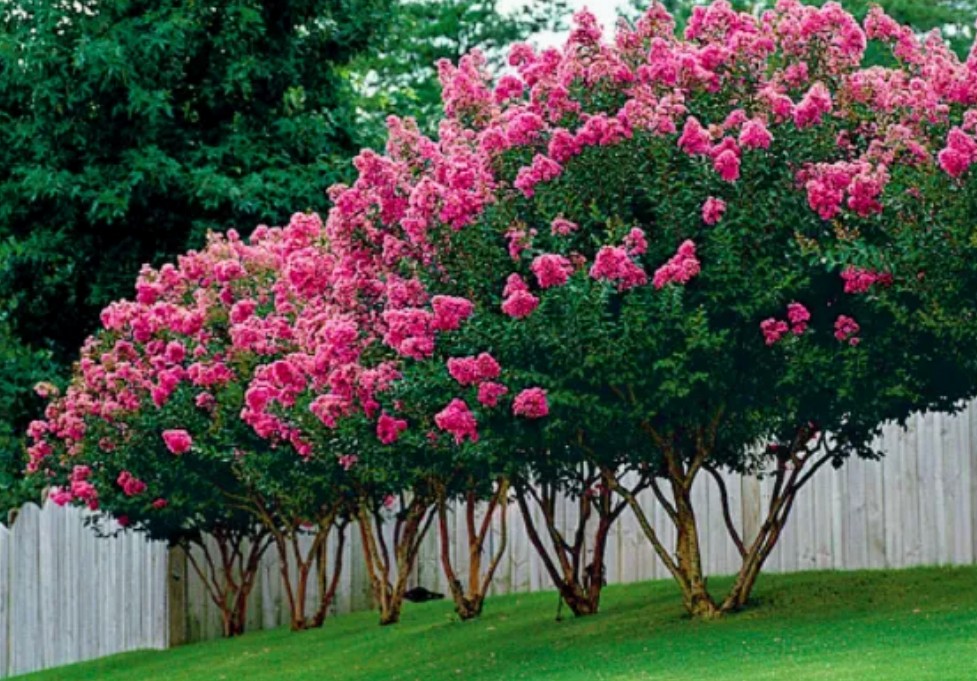
Crape Myrtle


Crape Myrtle
Lagerstroemia
Crape Myrtles are native to Sub-Tropical/warm temperate parts of Asia where summers
 are hot and winters are mild.
 They are fully hardy in USDA Zones 7-10,
 and are root hardy to USDA Zone 6, 
with some varieties hardy to USDA Zone 5. 
They are small trees typically growing no taller than 30'.
 Many dwarf cultivars exist.
 Some shrubs maturing to 2'-4' tall and wide,
 with many cultivars maturing to sizes between that and 30' tall.
 Noteable cultivars hardy to USDA Zone 5 (-20°F to -10°F)
 are Hopi, Acoma, Bellini Series, Tonto. 
All Crape Myrtles die back to the ground with 
temps below -5°F and in many cases below 0°F. 
In zones 7 and warmer for all Crape Myrtles the stems survive year after year. 
In zones 5 and 6 the tree forms usually die to the ground every year 
and obtain only a few feet tall and wide at maturity.
 They are very vigorous growers during the growing season though,
 and can grow anywhere from
 4'-8' in a single season especially when killed to the base.


Pictured is a Crape Myrtle that died back to the base from winter damage
 by temps dipping below 0°F.
(Not my picture found on the web)

Loblolly Pine The New Northern Pine

Loblolly Pine Pinus taeda The Loblolly Pine is widely known as the most common Pine tree in the South-Eastern United States. However, it is ...