Thursday, October 14, 2021

Christmas Trees that Grow in Indiana

 Christmas Trees that Grow in Indiana


Nothing beats the joy of a fresh cut Christmas tree! Did you know that most christmas trees that are sold at store fronts or nurseries are usually not grown locally? The most popular and common Christmas tree is Fraser Fir. Most Fraser Firs are actually grown on the mountains of North Carolina. You can support local Indiana Christmas tree farms too! I am going to go over the best Christmas trees to grow in Indiana.


Fraser Fir does grow here, but they have difficulty with our hot and humid Summers and wet clay soils. For this reason most are grown in cooler climates and are shipped here like from the Appalachian Mountains or Canada. 


Good alternative to Fraser Fir that is nearly indistinguishable is Canaan Fir


  1. Canaan Fir (Abies balsamea var. phanerolepis)

More tolerant of humid and wet clay soils than Fraser Fir. Looks identical. Is a subspecies of Balsam Fir. Less likely to suffer late spring frost damage unlike Fraser and Balsam, as Canaan breaks bud much later. Tiny very soft needles. Very dense growth. Perfect shape. Hardy in USDA Zones 4-7


  1. Scotch Pine (Pinus sylvestris)

Scotch Pine is a very cold hardy tree. As a long term landscaping tree, it is not recommended. They are very versatile for different soils and climates, but suffer major disease in the long term. For short term as a Christmas tree (around 10 years) it is an excellent choice. Has longer needles than Fir that are somewhat sharp, but very dense growing making it perfect to shear into a beautiful Christmas tree.  Hardy in USDA Zones 3-7


  1. Eastern White Pine (Pinus strobus)

Native to portions of Indiana primarily northern Indiana. Hardy throughout the state. Hot humid Summers don't bother this tree. The main thing that this tree hates is compacted soils and poor alkaline soils. White Pine gets chlorosis easily in alkaline soils and compacted clay soils. Make sure the soil is amended when planted, and if soil is alkaline to add soil acidifier to the soil. Very soft long needles that feel like a feather. They tend to drop older needles faster creating a less dense form. So it must be pruned more regularly than other trees in order to keep the desired dense shape.


  1. Concolor Fir (Abies concolor)

Concolor Fir is not super common in the Eastern US yet, but is quickly gaining popularity as a Christmas tree and as a landscaping tree. Very popular out west though. Long needles that point outward and upward that resemble more of a Pine than a traditional Fir, but are not prickly at all. Gives off a citrusy aroma, and much stronger when crushed. The needles have a dark green to blue colored needle. The Blue usually stands out more than the green adding a frosted look. Since this tree is native on the Coastal mountains it is sensitive to compacted soils. Make sure the soil is amended to be well draining. Thankfully is more tolerant of alkaline soils than other Conifers making this tree more adaptable to Indiana. 


  1. Virginia Pine

Not common as a Christmas tree in Indiana, more common in the South but still not overly popular choice. Native to the Appalachian Mountains parts of the South and Southern Indiana. Even though it grows in the South it is hardy even up through Northern Indiana. Hardy to -30°F. Short needles similar to Scotch Pine than compared to most Pines add a more compacted look that is suited for a Christmas tree. While not overly picky with pH, it performs best in well draining acidic soils, but will be forgiving in slightly alkaline.

Dwarf Chinkapin Oak

 Dwarf Chinkapin Oak

Quercus prinoides

Finally, an Oak SHRUB to add a new type of style to the landscape! 

The Dwarf Chinkapin Oak is a very rare small tree or large shrub in the wild and in commerce. This Oak species stays compact usually only getting 10'-20' tall and wide if never pruned. Due to its slow scrubby growth habit, it is very easy to train to a desired size of less than 8'.


Hardiness: USDA Zones: 5-9


Mature Size: 10'-15' tall and wide (rarely reaches 20')


Light: Full sun-part shade


Water:  Dry-moist


Soils: Acidic moist well draining soils are preferred. Very versatile. Drought tolerant. Will adapt to slight alkaline soils.


Deciduous/Evergreen: Deciduous

Little Henry Sweetspire

 Little Henry Sweetspire

 Itea virginica 'Sprich'

Little Henry Sweetspire is a wonderful addition to the landscape with white flowers that shoot out of the plant like fireworks! Blooms every year in late Spring/early Summer. Just when you thought the show was over, the fall color puts on a show of bright red.


Hardiness: USDA Zones: 5-9


Mature Size: 2'-3' tall and wide


Light: Full sun-full shade


Water:  Medium-Wet

Grows best in moist soils. Good drought tolerance once established. Grows in wet soils, as well as well draining soils.


Soils: Not particular with specific pH level. Grows best in moist soils. Tolerant of wet and even boggy soils. Good drought tolerance once established.


Deciduous/Evergreen: Deciduous

Tuesday, October 12, 2021

Sabal Minor

 Sabal Minor   Palmetto

Sabal Minor

This dwarf Palmetto is perhaps the most cold hardy Palm in the world next to Needle Palm (Rhapidophyllum hystrix). Sabal Palmetto is hardy to around 0°F when mature or perhaps subzero for brief periods. The Needle Palm has about the same hardiness but is said to withstand longer duration cold snaps than any other cold hardy Palm and will survive subzero temps briefly. What makes Sabal Minors so cold tolerant is the fact it's trunk and lower stems are below ground for protection. Only the oldest specimens can have small trunks and appear to be small trees, otherwise they are shrubs with fronds coming straight out of the ground. A wild cultivar called 'McCurtain' named after the county it is found McCurtain county, Oklahoma. Mature specimens have been found to survive -20°F, marking this cultivar as the most cold hardy Palm on Earth. However, the species itself is not even close to that hardy, only ones found in McCurtain County, OK have been found to be an exception. Even so being a Palm even the 'McCurtain' variety won't survive prolonged periods of subfreezing temps even if it doesn't get below zero, so protection is needed in areas colder than zone 7. Sabal Minors thrive in moist or wet areas, but can also thrive in dry sites too.


Hardiness: USDA Zones 7-11 

(Protected areas in zone 6b)


Mature Size:  3'-4' tall 

Very old specimens can have a small trunk and be tree like and be 6'-10' tall


Light: Full sun-Full shade

Thrives as understory Palms however growth will be faster in higher light level


Water: Dry-Moist

Performs best in moist well draining soils. Tolerates areas that have brief flooding or wet soils, but not consistently wet. Tolerant of drought/dry soils.


Soils: Not particular with specific pH level. Not particular with soil type, but grows best in moist well draining soils.


Deciduous/Evergreen: Evergreen


Native Range


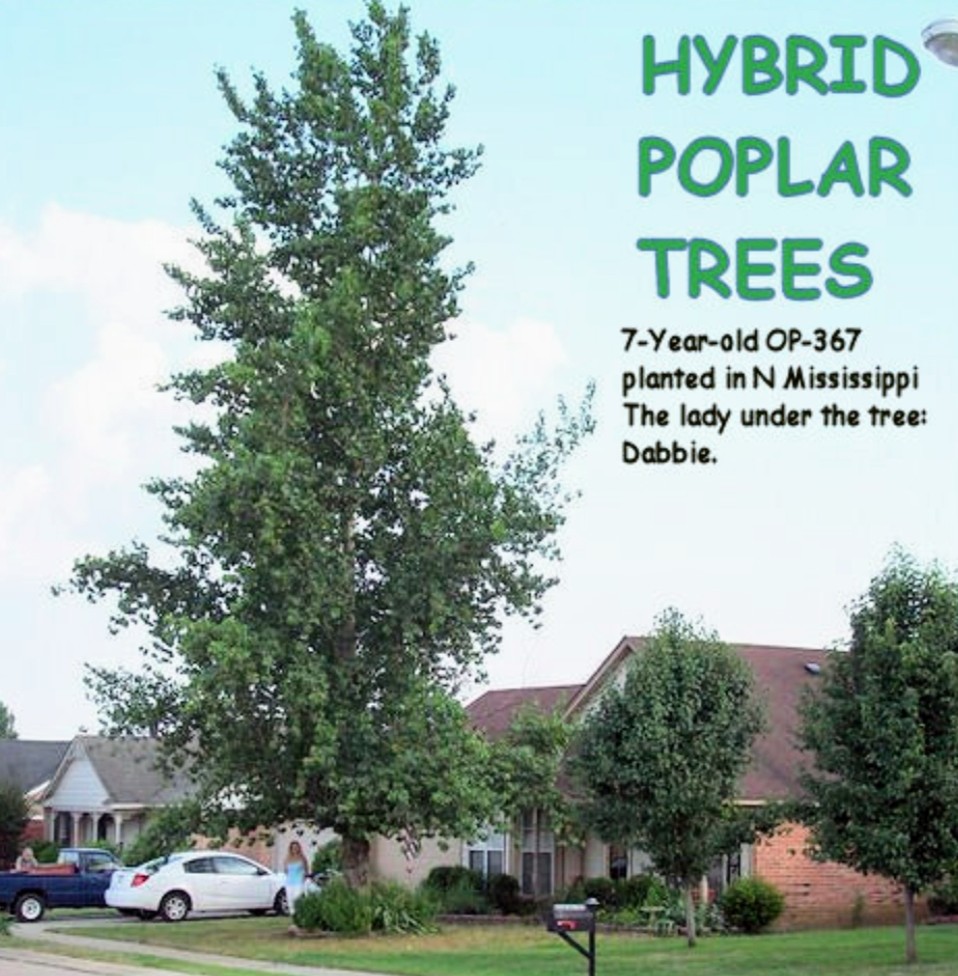
OP-367 Hybrid Poplar

 OP-367 Hybrid Poplar 

Populus deltoides × Populus nigra 'OP-367'

(Populus x canadensis 'OP-367')

This cultivar of a hybrid Poplar is very likely the fastest growing tree on Earth. While other Hybrid Poplars grow at 4'-6' per year, this cultivar in the right spot can grow more than 6' per year. The tree can grow to be over 50' tall within 10 years. They are capable of reaching over 75' tall in less than 20 years. This tree is rarely ever commercially available due to the fact nurseries can't compete with virtually every other tree that takes years to get to a substantial size, and the fact every branch of Hybrid Poplar can easily be propagated into new trees. However most urban homes don't want a tree growing that fast to outgrow their yard and home, so in most cases traditional shade trees are the best anyways. Cuttings are best taken when dormant to root to avoid shock with foliage. No rooting hormone is required as it releases its own natural hormone. Grows in virtually any environment from desert conditions to wet soils. However in very hot dry climates they will need some water support the first year. They also tolerate extraordinarily poor soils, and are planted near treatment plants to remove harmful waste in the soil, as they are one of the few trees that can take such pollution and thrive. For wholesale or commercial propagation cut back to the ground every year or other year and the tree will simply send new shoots from the base and this can be done indefinitely for nearly infinite cuttings to root. Can be cut for large firewood in as little as 2 or 3 years.  This tree is a hybrid Between the Black Cottonwood (native to Europe and Asia) and Eastern cottonwood (native to Eastern North America). This cultivar was selected at the Oxford Paper Nursery in New York State in the 1920s. Studies show the Black and Eastern Poplar hybrid produced the best versatility and growth of the other Poplars hybridized. The 'OP-367' cultivar was found to produce the most biomass of the Hybrid Poplars, and grow the fastest. Other online sources claim the 'OP-367' cultivar can grow up to 12' per year. However studies show the tree grows its most vigorously during its first growing season, and still very aggressive during its 2nd season. I suspect growth upwards of 6' per year continues until larger than 30' tall after a few years. 'OP-367' is a male clone so no cotton/seeds are produced. The tree is most easily sold/shipped as bare-root cuttings during dormant season, but some growers may ship them as rooted saplings. The Hybrid Poplar is hardy in USDA Zones 2-10. It grows in full sun. Not particular with soil type or pH, as it is extremely versatile. 


SOURCES

  1. https://aces.nmsu.edu/pubs/research/horticulture/BL805/welcome.html

  2. https://www.hybridpoplars.com/free-hybrid-poplar-cuttings/

  3. https://davesgarden.com/guides/pf/go/53617/#b

Saturday, October 9, 2021

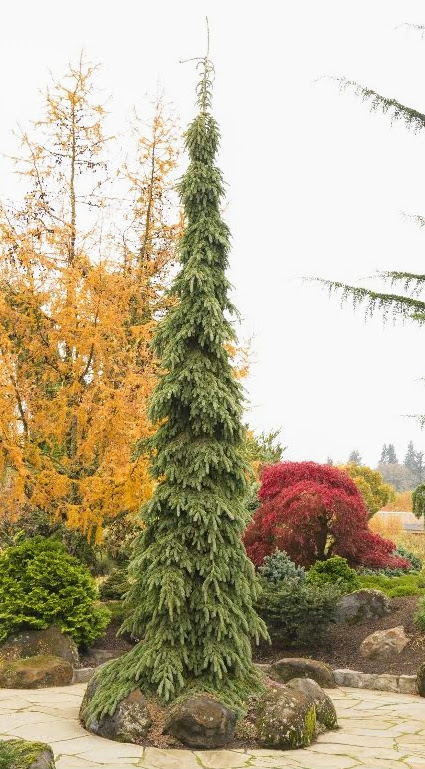
Weeping White Spruce

 Weeping White Spruce

Picea glauca 'Pendula'

Weeping White Spruce adds striking look to the landscape, with it's pendulous branches and tall skinny stature. Very narrow growth means it can be planted in a small space or near a foundation.


Hardiness: Hardiness: 

USDA Zones (1) 2-7

(unlikely to grow in most zone 1 locations, as summer temps usually aren't warm enough to support trees; struggles with summer heat in areas higher than zone 7)

Mature Size: 15'-20' tall by 4'-5' wide


Light: Full sun


Water: Dry-Medium 

Intolerant of wet soils. Excellent drought tolerance once established


Soils: Grows in most soils 

Performs best in well draining soils. Grows in most soil pH levels, prefers Acidic soils however.


Deciduous/Evergreen: Evergreen

Black Spruce

 Black Spruce

Picea mariana

Black Spruce is a great tree for wet sites and poor soil. Unlike other Spruce trees, this one grows where the soil never completely dries out. They naturally grow near bogs and swamps and occasionally near rivers. One of the most cold hardy evergreens to temps colder than -50°F.

Hardiness: USDA Zones (1) 2-6

(unlikely to grow in most zone 1 locations, as summer temps usually aren't warm enough to support trees; struggles with summer heat in areas higher than zone 5)

Mature Size: 30'-60' tall by 10'-25' wide


Light: Full sun-part shade


Water: Moist-wet

 Grows in the wettest areas, minor drought tolerance once established, young trees have no drought tolerance


Soils: Requires neutral to acidic soils; grows in the poorest soils

Intolerant of alkaline soils. Suffers in dry alkaline soils. Keep consistently moist and pH below a 7. Doesn't require good fertile soils to thrive.


Deciduous/Evergreen: Evergreen

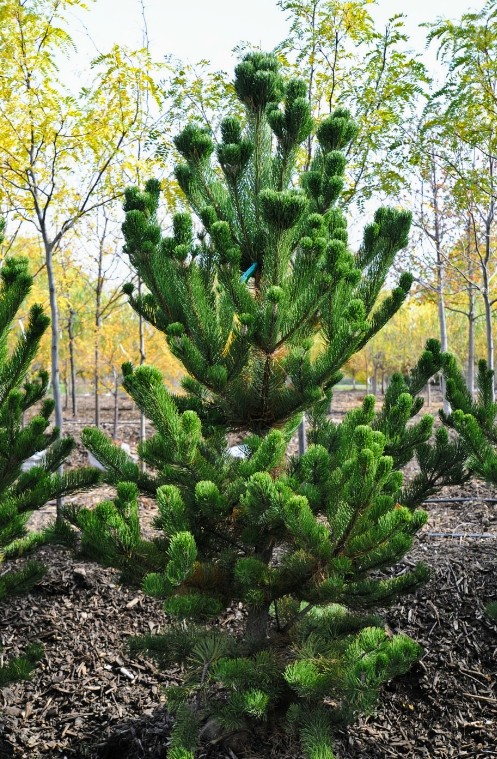
Oregon Green Austrian Pine

 Oregon Green Austrian Pine

Pinus nigra 'Oregon Green'

Austrian Pine has been a very popular landscaping trees across much if the US especially over the Eastern US as a landscape tree. Recently, they are dying to to diseases such as blight. Regular Austrian Pine is not recommended for landscaping. This cultivar is a compact form not getting very large, thus better suited as a landscape specimen and not very susceptible to disease. The needles are closely compacted adding texture to the landscape.


Hardiness: USDA Zones 3-7

Mature Size: 15'-20' tall by 10'-15' wide


Light: Full sun


Water: Dry-Medium

 Performs best well draining soils. Better tolerance to clay soils than other confiers.


Soils: Performs best in slightly acidic soils, but is adaptable to most soil conditions except wet soils.


Deciduous/Evergreen: Evergreen

Stowe Pillar White Pine

 Stowe Pillar White Pine

Pinus strobus 'Stowe Pillar'

Stowe Pillar is a dwarf fastigiate White Pine perfect for that small tight space! It is also great as a focal point specimen or many as a screen. Long feathery soft needles adds grace to your landscape!


Hardiness: USDA Zones 4-7

(Protected locations in zone 3)

Mature Size: 10'-12' tall by 3' wide


Light: Full sun-part shade


Water: Medium

 Requires well draining soils. Intolerant of severe drought. Grows best in Medium-Moist well draining soils..


Soils: Requires neutral to acidic soils, though is tolerant of mildly alkaline soils, but is Intolerant of high alkaline soils, as chlorosis will be a problem leading to death. Add HollyTone or acidic fertilizer to lower pH level. Performs best in medium-moist well draining soils. 


Deciduous/Evergreen: Evergreen

Japanese Maple

Japanese Maple

Acer palmatum

Japanese Maple is one of the oldest trees cultivated in the world. In Asia (Japan, Korea and China) it has been grown for gardens and landscaping for thousands of years. It is the most popular tree for bonsai making in Japanese culture next to wild Junipers. In the wild it is a scrubby tree only mature to 20'-25' tall and wide. In cultivation they can range from shrub forms to small trees. There is a lot of genetic variability in this species, that in fact thousands of cultivars exist on the market today. There are two categories these trees are placed in, either palmate cultivars or dissectum (aka. Laceleaf) cultivars. The dissectum cultivars have very open fern like leaves that are more scrubby rather than tree like. In the wild they have palmate foliage that are like pretty much all wild trees are green during the growing season, and their fall color turns to an orange to a deep burning red, but many in cultivation are bred to have deep red/purple leaves all season long. The most common Japanese Maples in landscaping have red foliage from Spring to Fall. Since Japanese Maples are not large shade trees, they have a slow growth rate. In many regions with hotter climates growth is about 6" per year on non-dwarf cultivars, and less than 6" per year on dwarf cultivars such as the dissectum cultivars. In ideal climates with cool summers non-dwarf cultivars can grow between 8"-12" per year and up to 6" or slightly more per year on Dissectum cultivars in places such as the West coast. 


Hardiness: USDA Zones 5-9

Mature Size: Typically 20' tall and wide 

Many cultivars exist with vastly different growing sizes. Most that aren't dwarf do eventually reach 20' tall and wide. Japanese Maples are notorious for getting as wide as they do tall, and sometimes slightly wider than tall.


Light: Part sun - Full shade

(full sun in cooler regions)


Water: Moist

 Prefers moist well draining soils. Adaptable to some drought once established.


Soils: Prefers slightly acidic soils

Prefers pH levels below 7. Can tolerate extremely acidic soils below pH 5. In alkaline soils add soil acidifier to lower pH level. It is adaptable to slightly alkaline soils, however it may not perform well overtime.


Deciduous/Evergreen: Deciduous

Loblolly Pine

 Loblolly Pine

Pinus taeda

Loblolly Pine is one of the most common evergreen trees in the US. It is extremely versatile and grows exceptionally well from poor moderately dry to nearly wet soils in its native range, and grows like a weed taking over fields or disturbed sites. It is perfect as a reclamation or erosion prevention tree. Wonderful as a screen due to extreme fast growth rate and versatility to harsh conditions. One of the fastest growing Pine trees in the world. It will put on several feet per year when young. While not super cold hardy, it is the hardiest of the Pines native to the deep South.


Hardiness: USDA Zones 6-9 (10)

(Horticulturalist Michael Dirr says he has seen them in Central Illinois but "barely surviving")

Mature Size: 40'-90' tall by 20'-40' wide


Light: Full sun


Water: Dry-Moist

 Extremely versatile. Tolerates poor soils from dry to moist and even occasional wet sites.


Soils: Performs best in moist acidic soils 

Will tolerate neutral to slightly alkaline, but doesn't perform its best. Add soil acid to lower pH if soil is alkaline. Tolerates dry to nearly wet soils. Tolerates clay to sand to anything In-between.


Deciduous/Evergreen: Evergreen

Loblolly Pine The New Northern Pine

Loblolly Pine Pinus taeda The Loblolly Pine is widely known as the most common Pine tree in the South-Eastern United States. However, it is ...