Saturday, October 9, 2021

Weeping White Spruce

 Weeping White Spruce

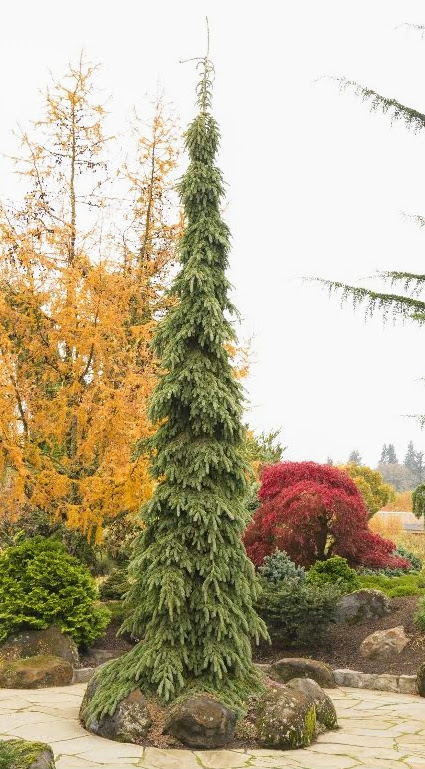
Picea glauca 'Pendula'

Weeping White Spruce adds striking look to the landscape, with it's pendulous branches and tall skinny stature. Very narrow growth means it can be planted in a small space or near a foundation.


Hardiness: Hardiness: 

USDA Zones (1) 2-7

(unlikely to grow in most zone 1 locations, as summer temps usually aren't warm enough to support trees; struggles with summer heat in areas higher than zone 7)

Mature Size: 15'-20' tall by 4'-5' wide


Light: Full sun


Water: Dry-Medium 

Intolerant of wet soils. Excellent drought tolerance once established


Soils: Grows in most soils 

Performs best in well draining soils. Grows in most soil pH levels, prefers Acidic soils however.


Deciduous/Evergreen: Evergreen

Black Spruce

 Black Spruce

Picea mariana

Black Spruce is a great tree for wet sites and poor soil. Unlike other Spruce trees, this one grows where the soil never completely dries out. They naturally grow near bogs and swamps and occasionally near rivers. One of the most cold hardy evergreens to temps colder than -50°F.

Hardiness: USDA Zones (1) 2-6

(unlikely to grow in most zone 1 locations, as summer temps usually aren't warm enough to support trees; struggles with summer heat in areas higher than zone 5)

Mature Size: 30'-60' tall by 10'-25' wide


Light: Full sun-part shade


Water: Moist-wet

 Grows in the wettest areas, minor drought tolerance once established, young trees have no drought tolerance


Soils: Requires neutral to acidic soils; grows in the poorest soils

Intolerant of alkaline soils. Suffers in dry alkaline soils. Keep consistently moist and pH below a 7. Doesn't require good fertile soils to thrive.


Deciduous/Evergreen: Evergreen

Oregon Green Austrian Pine

 Oregon Green Austrian Pine

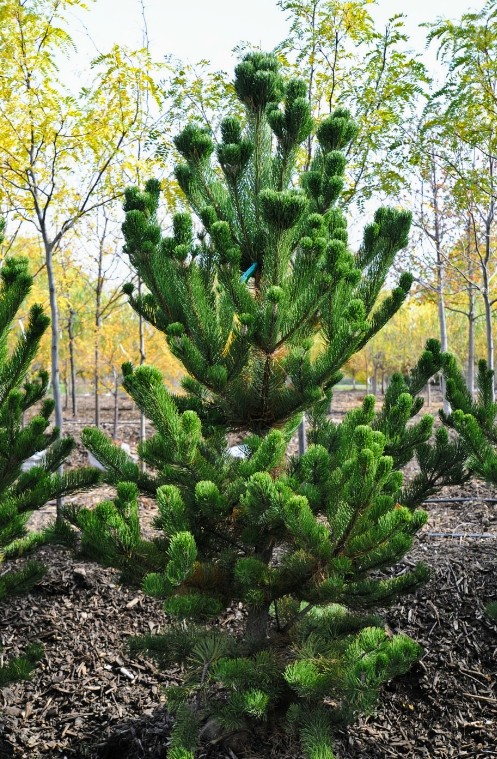
Pinus nigra 'Oregon Green'

Austrian Pine has been a very popular landscaping trees across much if the US especially over the Eastern US as a landscape tree. Recently, they are dying to to diseases such as blight. Regular Austrian Pine is not recommended for landscaping. This cultivar is a compact form not getting very large, thus better suited as a landscape specimen and not very susceptible to disease. The needles are closely compacted adding texture to the landscape.


Hardiness: USDA Zones 3-7

Mature Size: 15'-20' tall by 10'-15' wide


Light: Full sun


Water: Dry-Medium

 Performs best well draining soils. Better tolerance to clay soils than other confiers.


Soils: Performs best in slightly acidic soils, but is adaptable to most soil conditions except wet soils.


Deciduous/Evergreen: Evergreen

Stowe Pillar White Pine

 Stowe Pillar White Pine

Pinus strobus 'Stowe Pillar'

Stowe Pillar is a dwarf fastigiate White Pine perfect for that small tight space! It is also great as a focal point specimen or many as a screen. Long feathery soft needles adds grace to your landscape!


Hardiness: USDA Zones 4-7

(Protected locations in zone 3)

Mature Size: 10'-12' tall by 3' wide


Light: Full sun-part shade


Water: Medium

 Requires well draining soils. Intolerant of severe drought. Grows best in Medium-Moist well draining soils..


Soils: Requires neutral to acidic soils, though is tolerant of mildly alkaline soils, but is Intolerant of high alkaline soils, as chlorosis will be a problem leading to death. Add HollyTone or acidic fertilizer to lower pH level. Performs best in medium-moist well draining soils. 


Deciduous/Evergreen: Evergreen

Japanese Maple

Japanese Maple

Acer palmatum

Japanese Maple is one of the oldest trees cultivated in the world. In Asia (Japan, Korea and China) it has been grown for gardens and landscaping for thousands of years. It is the most popular tree for bonsai making in Japanese culture next to wild Junipers. In the wild it is a scrubby tree only mature to 20'-25' tall and wide. In cultivation they can range from shrub forms to small trees. There is a lot of genetic variability in this species, that in fact thousands of cultivars exist on the market today. There are two categories these trees are placed in, either palmate cultivars or dissectum (aka. Laceleaf) cultivars. The dissectum cultivars have very open fern like leaves that are more scrubby rather than tree like. In the wild they have palmate foliage that are like pretty much all wild trees are green during the growing season, and their fall color turns to an orange to a deep burning red, but many in cultivation are bred to have deep red/purple leaves all season long. The most common Japanese Maples in landscaping have red foliage from Spring to Fall. Since Japanese Maples are not large shade trees, they have a slow growth rate. In many regions with hotter climates growth is about 6" per year on non-dwarf cultivars, and less than 6" per year on dwarf cultivars such as the dissectum cultivars. In ideal climates with cool summers non-dwarf cultivars can grow between 8"-12" per year and up to 6" or slightly more per year on Dissectum cultivars in places such as the West coast. 


Hardiness: USDA Zones 5-9

Mature Size: Typically 20' tall and wide 

Many cultivars exist with vastly different growing sizes. Most that aren't dwarf do eventually reach 20' tall and wide. Japanese Maples are notorious for getting as wide as they do tall, and sometimes slightly wider than tall.


Light: Part sun - Full shade

(full sun in cooler regions)


Water: Moist

 Prefers moist well draining soils. Adaptable to some drought once established.


Soils: Prefers slightly acidic soils

Prefers pH levels below 7. Can tolerate extremely acidic soils below pH 5. In alkaline soils add soil acidifier to lower pH level. It is adaptable to slightly alkaline soils, however it may not perform well overtime.


Deciduous/Evergreen: Deciduous

Loblolly Pine

 Loblolly Pine

Pinus taeda

Loblolly Pine is one of the most common evergreen trees in the US. It is extremely versatile and grows exceptionally well from poor moderately dry to nearly wet soils in its native range, and grows like a weed taking over fields or disturbed sites. It is perfect as a reclamation or erosion prevention tree. Wonderful as a screen due to extreme fast growth rate and versatility to harsh conditions. One of the fastest growing Pine trees in the world. It will put on several feet per year when young. While not super cold hardy, it is the hardiest of the Pines native to the deep South.


Hardiness: USDA Zones 6-9 (10)

(Horticulturalist Michael Dirr says he has seen them in Central Illinois but "barely surviving")

Mature Size: 40'-90' tall by 20'-40' wide


Light: Full sun


Water: Dry-Moist

 Extremely versatile. Tolerates poor soils from dry to moist and even occasional wet sites.


Soils: Performs best in moist acidic soils 

Will tolerate neutral to slightly alkaline, but doesn't perform its best. Add soil acid to lower pH if soil is alkaline. Tolerates dry to nearly wet soils. Tolerates clay to sand to anything In-between.


Deciduous/Evergreen: Evergreen

Hot Wings Tatarian Maple

 Hot Wings Tatarian Maple

Acer tataricum 'GarAnn'

Hot Wings is a variety of Tatartian Maple that has been bred to have burning red smaras (aka seeds) that add a color pop during the Summer months. This tree is also more tolerant of poor soils and high pH than other Maples. Smaller tree is excellent for smaller landscapes or closer to a foundation. Popular as a clump form as an accent tree. 

Hardiness: USDA Zones 3-9

Mature Size: 15'-18' tall by 15'-18' wide


Light: Full sun-Part Shade 


Water: Dry-Moist

 Very versatile; grows from moist (occasional flooding) to drier soils. 


Soils: Grows in most soils 

Thrives in acidic to slightly acidic soils, but is adaptable to poorer alkaline soils. Drought tolerant once established. 


Deciduous/Evergreen: Deciduous

Eastern Red Cedar

 Eastern Red Cedar

Juniperus virginiana

Eastern Red Cedar (actually a Juniper) is the most widely distributed evergreen conifer in the Eastern US. Growing thickets along roadsides, disturbed sites, edges of woods, and plains. They are even know to grow like weeds in the Southern and Eastern US. They make perfect privacy screens, very cold hardy, grow in poor soils. Very drought tolerant and grows in full sun. Eastern Red Cedar is also cultivated in landscaping with many cultivars on the market. My top favorites are 'Canaertii' and 'Taylor'. 'Canaertii' has branches that grow outwards in various directions adding a unique more wild look to the landscape. 'Taylor' is extraordinarily columnar. It will grow up to 30' tall but only stay 2'-3' wide at maturity. I call it the "Italian Cypress of the North". In parts of the Southeastern US they commonly grow on cliffs and on limestone.

'Canaertii'

'Taylor'

Wild Eastern Red Cedar growing on Limestone


Hardiness: USDA Zones 3-9


Mature Size: Ranging is size from 25'-60' tall by 10'-25' wide 

(Poor soils and conditions naturally leads to smaller trees, but doesn't always worsen  health, and will still thrive)


Light: Full Sun


Water: Dry

Performs best in well draining soils.


Soils: Not particular with specific pH level. Not particular with soil type, but grows best in slightly acidic well draining soils. Thrives in clay soils, as long as adequate drainage is provided. 


Deciduous/Evergreen: Evergreen


Native Range

'Nellie R. Steven's' Holly

Nellie R. Stevens Holly

Ilex aquifolium × Ilex cornuta 'Nellie R. Stevens'

This Holly is one of the most popular Hollys to grow as a screen in the Southern US. Unlike other Hollies, Nellie R. Stevens is more tolerant of high heat and humidity of the South. Thus, this Holly can grow into Southern Florida where others can not. This hybrid is a cross between the infamous English Holly and the lesser known Chinese Holly. Hollies are diocious which means they require a male to pollinate the female so the female can produces berries. However, what is very unusual amongst diocious plants is that Nellie R. Stevens will produce some berries without a male pollinator because it is parthenocarpic (from Greek parthenos meaning virgin and karpos meaning fruit). In order to have the gorgeous profuse abundance of berries will require a male pollinator. Good male pollinators include 'Edward J. Stevens' or any male Chinese Holly. Nellie is cold hardy to -10°F to -5°F. She can be pruned to be a single trunk tree or have limbs to the ground. She can be a stand alone focal/accent or planted together as a screen which is most popular in landscaping.


Hardiness: USDA Zones 6-10 (Protected areas of zones 5b/6a)


Mature Size: 20'-30' tall by 10'-15' wide


Light: Full sun-Part Shade 

(Tolerant of some shade; will become very sparse with fewer berries in dense shade)


Water: Average-Moist

 Extremely versatile for a Holly. Tolerates poor soils from dry to moist. Will tolerate some flooding.


Soils: Performs best in acidic soils 

Unlike most Hollies this hybrid will tolerate slightly alkaline soils, but will not survive very high pH. Add soil acid to lower pH if soil is alkaline. Tolerates dry to moist soils. Very versatile compared to other Hollies; Tolerates compacted soils, and sandy soils. 


Deciduous/Evergreen: Evergreen

Monday, September 6, 2021

Southern Magnolia More Hardy than You Think

 Southern Magnolia

Magnolia grandiflora

The Southern Magnolia is perhaps the most popular broadleaf evergreen tree in North America. Very large glossy (plastic like) green leaves can be up to 10" long and large very fragrant flowers that are citrusy in smell that can be up to 12" long. Due to mass cultivation of this species it has naturalized much further North than its historical native range (I circled). Cultivars exist that are more cold hardy that grow a zone North than the regular species can tolerate. The Southern Magnolia is hardy in USDA Zones 6-10. A couple cultivars that are zone 5 hardy are 'Bracken's Brown Beauty' and 'Edith Bogue'. The large deep glossy foliage adds a lush tropical look to the frigid and gray Northern landscape. 


Magnolias in general prefers soil more on the moist side rather than drier side. The species depends on exactly what they prefer. Southern Magnolia prefers moist well draining soils. They are drought tolerant once established. They can not tolerate wet soils, but can tolerate occasional flooding. The other species of Magnolia The Sweetbay Magnolia tolerates wet soils al the way to even some drought. The main physical difference is Sweetbay has much smaller foliage and blooms. The other phsyical difference between the two is that Sweetbay Magnolia is semi-evergreen/deciduous in Northern regions.


Many cultivars of Southern Magnolia exist from columnar, dwarf, to improved foliage.. the 'Little Gem' cultivar is dwarf not getting bigger than 20' tall, but is less hardy than the regular species hardy only in zones 7-10. 'Alta' is very columnar cultivar for small or tight spaces. Also the the ones more cold hardy are listed above. Southern Magnolia is most popular within the US, but is cultivated around the world due to its unique qualities you can't find with any other tree. It is native to the Southeastern US. It has naturalized all the way to Arkansas, Tennessee, Washington DC and others. The species only is native in USDA Zones 8-10a (10a being Tampa the Southern most tip of the native range) I have seen the tree landscaped as far South as zone 10a in Naples Florida. The trees seemed stunted and performing poorly, likely too hot with limited dormancy periods. Very much like Boxwood in zone 10 that gets more disease issues with the hotter climate. The Southern Magnolia performs best in zones 6-9, but is capable of growing in zone 10, but extra water or some afternoon shade may be required. I have successfully grown 'Edith Bogue' Southern Magnolia in Carmel, IN (USDA Zone 5b). At the coldest point it survived -13°F with severe winter burn, but every branch foliated the following Spring. There is a mature specimen in Carmel as well that has endured temps slightly colder than -20°F in the winter of 2014 with nearly complete defoliation, but every limb survived and foliated the following Spring.

Native Range of Magnolia grandiflora


Area circled is Magnolia grandiflora rough generalization of species being naturalized beyond native range (naturalization may occur outside circle especially along East Coast)


'Edith Bogue' Southern Magnolia in Carmel, IN (USDA Zone 5b) 2014 winter for example saw air temps pummet to -20°F with wind chills close to -50°F. Tree nearly completely defoliated, but every single branch survived and flushed out the following Spring. Winter burn begin when winter temps dip below -5°F to 0°F, but stems are hardy to at least -20°F on the hardiest cultivars. Even if a night or 2 falls below zero, the foliage out of direct winds wind face a better chance at staying green, especially if the subzero is brief.

Tuesday, August 17, 2021

Sabal Palmetto


Sabal Palmetto (State tree of Florida and South Carolina)


Native Range (Native also in the Caribbean and Cuba)


Sabal Palm is a lush sub-tropical evergreen, and is the state tree of Florida and South Carolina. One of the most cold hardy Palm trees in the world down to around 7°F. Landscaped all the way up to Tennessee, Virginia, Maryland…

These trees mature anywhere between 30' to 60' tall. A few rare specimens likely over 150 years old have exceeded 90' in height. These trees are painfully slow to grow from seed to desired size. From germination to the first sign of a trunk (4'-5') tall can take at least 10-15 years! This means 20' tall specimens are about 50 years old, and 30'-40' tall specimens are 70-95 years old. This also means the millions of Sabal Palmettos landscaped over 20' tall across the deep South are at least 50 years old. So obviously these trees are not propagated from seed in nurseries. Most of the time they are dug from the wild from private land. Young trees with trunks less than 3' are almost impossible to transplant, but tall ones are extraordinarily easy, and are foolproof option for landscaping. There remains debate how much longer we can keep digging them up from the wild before there aren't enough left to meet the demand. So many nurseries are now growing them from seeds so decades from now Sabal Palmettos will still be readily available when we can't continue to mass dig them from the wild. Super drought tolerant, tolerant of virtually any pH and soil type, and very salt tolerant.


Hardiness: USDA Zones: 7b-11


Mature Size: 30'-60' tall by 5'-15' wide (Few very old wild specimens grow to 90'+ tall)


Light: Full Sun-Part Shade


Water:  Dry-Moist

Grows best in moist well draining soils. Excellent drought tolerance once established. Tolerates wide moisture conditions from drought to moist soils, and some flooding.


Soils: Not particular with specific pH level. Grows in most soils. 


Deciduous/Evergreen:

Evergreen


SOURCE:

https://www.plantrealflorida.org/info/florida-ecosystems/sustaining-the-sabal-palm-floridas-state-tree/

Loblolly Pine The New Northern Pine

Loblolly Pine Pinus taeda The Loblolly Pine is widely known as the most common Pine tree in the South-Eastern United States. However, it is ...