Wednesday, October 30, 2019

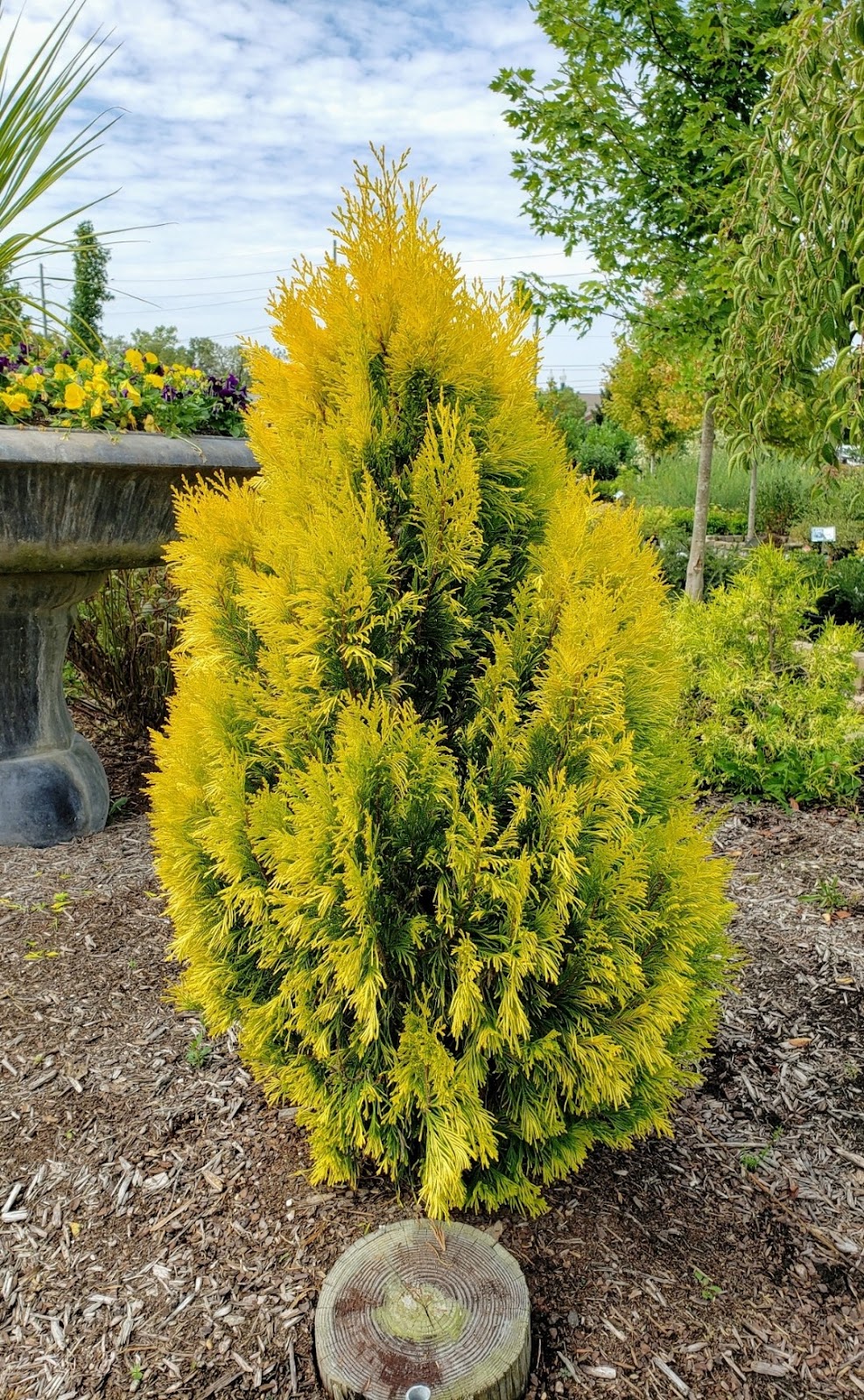
Forever Goldy Arborvitae


Forever Goldy
 Arborvitae
Thuja plicata '4EVER'
Forever Goldy Arborvitae is the best golden evergreen there is! It has deep yellow foliage that doesn't fade in the summer heat unlike many other golden evergreens. Dwarf evergreen, perfect for right near a foundation or small spaces.
Hardiness: USDA Zones 5-8

Mature Size: 10'-12' tall by 3'-4' wide

Light: Full sun

Water: Medium 
Drought tolerant once established

Soils: Not particular on specific pH level. Grows in most soils,
 except consistently wet sites. 
Tolerant of Dry-Moist soil types.


Deciduous/Evergreen: Evergreen

Fire Chief Arborvitae

Fire Chief Arborvitae
Thuja occidentalis 'Congabe'
The Fire Chief Arborvitae is a colorful evergreen, adding year round color to the landscape! Older foliage is lime green, but newer growth is deep orange. This orange color persists all year! A sport of the Rheingold Arborvitae, Fire Chief is more mounded and suitable for smaller landscapes.

Hardiness: USDA Zones 5-7 
(zone 4 in protected locations)

Mature Size: 2'-4' tall and wide

Light: Full sun-Part shade 
(best orange color in full sun)

Water: Medium-Moist 
Grows best in moist soils, intolerant of severe drought. 

Soils: Grows in most soils, but performs best in slightly acidic soils. 
Best in clay or loamy clay soils where water won't drain as quickly especially
 in dry periods. 

Deciduous/Evergreen: Evergreen

Dwarf Sweetbay Magnolia


Sweet Thing Sweetbay
 Magnolia 
'Perry Paige'
Magnolia virginiana var. australis 'Perry Paige'
Only evergreen shrub Magnolia there is! Doesn't get winter burn at temps below 0°F like the regular species. Retains green leaves to temps colder than -10°F. Root hardy to temps colder than -20°F. Perfect for containers, keep small with pruning. 


Hardiness: USDA Zones 5-9

Mature Size: 10'-15' tall by 10' wide

Light: Full sun to Part shade

Water: Medium-Wet 
Tolerates wet sites, tolerates some dry conditions, but is intolerant of severe drought

Soils: Performs best in Neutral to Acidic soils. Suffers in high alkaline soils.
 Add HollyTone or Acid fertilizer to lower pH level.

Deciduous/Evergreen: Evergreen

Thursday, October 3, 2019

Top 10 Best Houseplants

This is a list of the top 10 best Houseplants. I typically define a houseplants into 2 categories.

1. Low water needs
2. Low light

So water a minimum of at least once or twice per week, and can tolerate low lighting. There are some exceptions, like Lucky Bamboo as a good example. It needs consistent moisture, but I still qualify it as a Houseplant. It is grown hydroponically in water and not soil, so it doesn't need constant maintenance. It is very tolerant of low light, and the water only needs to be refilled once every several days, and replaced once every several weeks or so. It is very low maintenance, so it is considered a Houseplant. There are countless houseplants on the market, including common and very rare finds. I could go on forever naming plants, but for the sake of you the reader I have narrowed it down to my top 10 favorite. This is to help amateurs, and new plant growers to start, and help with the best low maintenance plants for their home and or office! 🌿


1. Sansevieria spp.

Light: Low light

Water: Low. Water once every 1-2 months.

Info: Known to be impossible to kill, likely the most low maintenance houseplant in existence!

2. Dracaena fragrans

Light: Low to Moderate

Water: Low. Water once every few weeks to once per month.

Info: One of the most low maintenance houseplants in existence!

3. Dracaena marginata

Light: Low to Moderate

Water: Low. Water once every 2 weeks, or when soil is completely dry a few inches deep.

Info: Extremely low maintenance, in the top most low maintenance Houseplants you can get!

4. Pothos Vine


Light: Low

Water: Low. Water once every few weeks, or when soil s completely dry a few inches deep.

Info: One of the most low maintenance houseplants on the market!

5. ZZ Plant

Light: Low

Water: Low. Water once every few weeks, or when soil gets completely dry a few inches deep.

Info: Extremely low maintenance, and in the top most low maintenance in existence!

6. Schefflera spp.

Light: Low to high

Water: Low. Water once per week, or when soil is dry to the touch

Info: Extremely low maintenance!

7. Norfolk Island Pine 

Light: Low to high

Water: Low. Water once per 1-3 weeks, or when soil is completely dry a few inches deep.

Info: Tropical Pine, while not a true Pine, a conifer non the less. Very low maintenance

8. Spider Plant

Light: Low

Water: Low to moderate. Water once per week or slightly longer, or when soil is completely dry to the touch.

Info: A true classic Houseplant, very low maintenance!

9. Parlour Palm

Light: Low

Water: Low to moderate. Water once every 1-2 weeks, or when soils is completely dry to the touch.

Info: A true dwarf Palm tree, only maturing a couple feet tall after many years. Very low maintenance!

10. Lady Palm

Light: low to moderate

Water: Low to moderate. Water once every 1-2 weeks, or when soil is completely dry a few inches deep.

Info: Very low maintenance Palm tree! Somewhat rare in commerce, but a true gem if you can find one!
Saturday, September 14, 2019

10 Best Screening Evergreens for Zone 5


There are so many choices, yet hard to know what is best. Certain trees may not be hardy, or get too large, or don't stay evergreen through the rough winters. In this post I will be sharing the best evergreens that are perfect for a screen!


1. Green Giant Arborvitae (Thuja standishii x plicata)

Hardy in USDA Zones: 4-8. Matures to 30'-40' tall by 15'-20' wide. Perfect screening tree for large areas, where dwarf screening plants are not efficient. Extremely fast growing at 3' per year. Even starting with small specimens, you will have your screen in no time!

2. Emerald Green Arborvitae (Thuja occidentalis 'Smaragd')

Hardy in USDA Zones: 3-7 (winter burn can occur in direct winter winds in zone 3) Matures to 12'-15' tall by 4'-5' wide. Perfect dwarf screening evergreen for small/tight spaces.

3. American Holly (Ilex opaca)

Hardy in USDA Zones: 5-9. Matures to 30'-60' tall by 15'-30' wide. (Usually doesn't get larger than 30' tall by 15' wide at maturity in Zones 5-6) Requires acidic soils. In soils with high pH, apply HollyTone or acidic fertilizer. Perfect broadleaf evergreen as a screen! Green leaves that persist all winter, and bright red berries that attract lots of birds around the holidays will surely bring cheer!


4. Yew spp. (Taxus spp.) 

There are several Yew species and too many cultivars to count. With so many options to choose from there are dwarf (shrub) forms or large shrubs used as screens. Some cultivars that can be used as screens include 'Hick's', 'Captain'... Matures to 10'-15' tall by 5'-8' wide. Some Yews exist that can reach 30' tall and wide or bigger, but those are extremely difficult to manage and are not recommended for screening. Most are hardy in USDA Zones: 4-7.

5. Norway Spruce (Picea abies)

Two cultivars in my opinion are the best for screening. First one is 'cupressina' Norway Spruce. Matures to 15'-20' tall by 5'-8' wide. Second one grows a bit wider to fill more space as a screen. It is 'Sherwood Compact'. Matures to 10'-15' tall by 8'-10' wide. Norway Spruce is hardy in USDA Zones: 2-8.

6. 'Degroot's Spire' Arborvitae (Thuja occidentalis 'Degroot's Spire')

Similar to the Emerald Green, but has a more neat compact look. It grows to the same height but is slightly more narrow than the Emerald Green. Matures to 15' tall by 2'-4' wide. Hardy in USDA Zones: 3-7 (Winter burn can occur in direct winter winds in zone 3)

7. Leyland Cypress (Cupressus x leylandii)

Hardy in USDA Zones: 5-10 (In zone 5 winters can suffer winter burn in exposed windy sites. Plant in protected spot) Very fast growing at nearly 3' per year! Even starting with small plants, you will have your screen in no time!


8. 'Taylor' Juniper (Juniperus virginiana 'Taylor')


The most upright of any Eastern Red Cedar! As narrow as an Italian Cypress, but is MUCH more cold hardy! Perfect for narrow areas where wide plants are not possible. Matures to 30' tall by 2'-3' wide. Hardy in USDA Zones: 3-9

9.  Black Hills White Spruce (Picea glauca 'Densata')

Compact Spruce that stays smaller than other Spruces. Can exceed 50' in height in cool climates where summers rarely get warmer than 80°F, and the soil and geography is very rocky or mountainous, but in most areas in the Eastern US that is not likely. Has good resistance to needle cast disease which is terrible in Blue Spruce. Matures to 30' tall by 15' wide. Hardy in USDA Zones- 2-7.

10. Eastern Hemlock (Tsuga canadensis)

The Eastern Hemlock is a gorgeous tree with soft needles that have a pendulous nature. Responses very well to heavy pruning. Can be kept small as a screen or large hedge, otherwise matures to 50'-75' tall by 25'-40' wide. Hardy in USDA Zones: 3-7. One of the few evergreen conifers to grow in shade and moist soils. Grows in full sun as well. It is not tolerant of severe drought. It is highly susceptible to a deadly disease called Wooly Adelgid. As of now it is only found east of the Appalachian Mountains. So the Western US, Plains, and Midwest should not worry about this pest. Requires acidic soils. If soils are not acidic, simply apply HollyTone, or acid fertilizer.


NOTE: Please do research on plants before buying and planting them. Different plants require different growing conditions, such as light, water, cold hardiness, soil type, and pH level

Tuesday, August 20, 2019

Needlecast Disease on Conifers and Alternatives


Needle Cast disease is killing millions of Blue Spruce trees across the Eastern US. The tree in native to the dry arid climate of the Rocky Mountains. Clay soils, high humidity and water puts tremendous stress on these trees and hosts multiple diseases. The tree has no mechanism to fight it off since it never encounters them in their native habitat. The disease that is of most concern is Rhizosphaera Needle Cast disease is killing millions of Blue Spruce trees across the Eastern US. The tree in native to the dry arid climate of the Rocky Mountains. Clay soils, high humidity and water puts tremendous stress on these trees and hosts multiple diseases. The tree has no mechanism to fight it off since it never encounters them in their native habitat. The disease that is of most concern is Rhizosphaera Needle Cast disease. This starts by killing off the tree at the bottom, and works its way up to the top. The needles will turn a purple/brown color, then drop. There is no cure, and no treatment is proven to work. Some nurseries sell fungicide to kill the disease, it is not porven, nor does it work on already infected trees. It MAY only work on new growth that hasn't been affected yet. Trees that are most susceptible are Blue Spruce (Picea pungens), and Engelmann Spruce (Picea engelmannii). White Spruce has good resistance to the disease, and is a good alternative to Blue Spruce. Serbian Spruce, and Oriental Spruce haven't been planted in North America long enough to know if they are susceptible to the disease, but as of now very few problems have come up with the trees so they may be a good alternative

Alternatives:

1. As mentioned above White Spruce, also it's variety Black Hills.
2. Reportedly has some resistance: 'Fat Albert' and 'Hoopsi' Blue Spruce (still susceptible though!)
3. White Fir (Blue cultivars: 'Candicans' and 'Blue Cloak')
4. 'Norway Spruce (Blue cultivar: 'Paul's Select')
5. Oriental Spruce (Bluish cultivar: 'Deer Run') (May be susceptible)
6. Serbian Spruce (Deeper Green and bluish cultivar: 'Bruns') (May be susceptible)


Pictures below I have taken. My 'Fat Albert' Blue Spruce in my yard has zero sign of Needle cast. While my neighbors Blue Spruce trees are dying from Needlecast. This may be an indication of the resistance to Needlecast in my 'Fat Albert'. It has been in the ground for almost 7 years.


Tuesday, July 30, 2019

Growing Leyland Cypress

meLeyland Cypress is a hybrid between the Monterey Cypress and the Alskan Cedar. Leyland Cypress is one of the few confiers that can successfully grow in the deep South. Hardy in USDA Zones: 5b-10. When growing anywhere in Zone 5, it must be planted in a protected location. Leyland Cypress will survive without any winter damage to -10°F. Winter damage occurs with temps colder than that, and ultimately death for pronged time. Zone 5 gardeners have had success growing these tree in sheltered locations. These trees have endured temps down to -20°F, but only survive becuaee they are protected for winter winds. Any exposure to wind, or prolonged exposure to temps colder than -10°F will kill the tree. My personal favorite cultivar is the 'Gold Rider' Leyland Cypress. It has deep golden yellow foliage that persisits all year. It has branches the branch outwards gracefully from the rest of tree, the gold color makes this even more striking to the eye! Leyland Cypress can grow in most soils, and isn't picky on certain pH. One disadvantage is that it struggles in drought. It has only minor drought tolerance once established. So in any extreme drought, it is best to irrigate your trees. Leyland Cypress is a popular Christmas tree in the deep South, parts of the southwest, and Hawaii due to being one of the few conifers to grow in a sub-tropical climate. Mostly grown for privacy screens.


Monday, July 22, 2019

Quaking Aspen

Quaking Aspen is a gorgeous mountain tree that reminds me of the Arctic. It has powdery white bark, and leaves that quake violently with the slightest breeze. Quaking Aspen (Populus tremuloides) is hardy in USDA Zones: 1-6. In areas of USDA Zones 5 and 6 with hot and humid summers the Quaking Aspen can have many disease problems. The most common is fungal diseases. They can be easily treated. The fungal issues can be treated with a fungicide. The Quaking Aspen is native to the northern half of Indiana. I live in the northern suburbs of Indianapolis. I have seen some wild patches growing on the edges of woodlands near my home. I am in USDA Zone 5b. There are some landscaped at a local nursery. They get terrible fungal problems that turn the leaves black then they fall off. They have spray fungicide on them a couple times during the growing season. This significantly reduces the disease on them. Now it is very spotty, but mostly green. These trees are very versatile on growing conditions. They can grow in arid rocky soils, to wet boggy sites. Found throughout the Rocky Mountains out west, and along streams and lowlands. There is a cultivar available called the 'Prairie Gold' Aspen that is highly tolerable to the heat and humidity of the east. It gets little disease problems, and has been grown all the to zone 8 with little problems. The cultivar was found in a prairie in Nebraska.

                                                            Native Range


Indiana Native Range


 Indiana USDA Zone Map


 Took these 2 pictures in Colorado


Wild clump near my home


Sunday, May 12, 2019

Best Golden Evergreens


1. Golden Mop Cypress
USDA Zones: 4-8
Moisture: Medium (tolerates drought)

2. 'Forever Goldy' Arborvitae
The most golden Arborviate I know of.
USDA Zones: 4-7
Moisture: Medium (tolerates drought)

3. 'Gold Rider' Leyland Cypress
USDA Zones: 5-10
Moisture: Medium

4. 'Sea of Gold' Juniper
USDA Zones: 3-8
Moisture: Dry-medium

5. 'Louie' White Pine
USDA Zones: 3-8
Moisture: Dry- medium

6. 'Gold Cone' Juniper
USDA Zones: 2-7
Moisture: Dry


'Edith Bogue' Southern Magnolia Update: 5/12/19

My 'Edith Bogue' Southern Magnolia survived the winter just fine with winter burn. The tree is shedding all the dead leaves, and every single branch is alive and sending up new shoots. Reached a temp of -13°F with winds over 30 mph back on January 31. So excited to see it fill back in! 😁

Indianapolis, IN
USDA Zone: 5b


NatureMan


Circles show where new bud grow


Monday, May 6, 2019

Shade Perennials

Perennials that grow in the shade can be hard to find, many gorgeous perennials grow in full sun. There are beautiful shade loving perennials you can buy! Here are the top 10 best shade loving perennials.

1. Variegated Solomon's Seal (Polygonatum odoratum var. pluriflorum 'Variegatum')

Hardy in USDA Zones: 3-8. Moisture: medium to wet soils.

2. Coral Bells (Heuchera spp.)

Hardy in USDA Zones: 4-9 Moisture: medium to moist

3. Hostas (Hosta spp.)

Hardy in USDA Zones: 3-9 Moisture: Medium

4. Japanese Forest Grass (Hakonechloa macra)

Hardy in USDA Zones: 5-9 Mositure: Medium to moist

5. Bleeding Heart (Dicentra spectabilis)

Hardy in USDA Zones: 3-9 Moisture: Medium.

6. Pachysandra (Pachysandra terminalis)

Hardy in USDA Zones: 3-9 Moisture: Dry to moist

7. English Ivy (Hedera helix)

Hardy in USDA Zones: 5-11 Moisture: Medium to moist (tolerates drought once established)

8. Vinca Myrtle (Vinca minor)

Hardy in USDA Zones: 4-8 Moisture: dry to medium

9. Columbine (Aquilegia spp.)

Hardy in USDA Zones: (3)4-8 Moisture: medium

10.Virginia Bluebells (Mertensia virginica)

Hardy in USDA Zones: 3-8 Moisture: medium


Loblolly Pine The New Northern Pine

Loblolly Pine Pinus taeda The Loblolly Pine is widely known as the most common Pine tree in the South-Eastern United States. However, it is ...